Why Your Neck Hurts More in the Evening Once the Clocks Are About to Change
Quick Answer: As evenings get darker you move closer to screens, tilt toward light sources, and spend more time on the sofa with a device. Low light also makes you lean in to read, and cold rooms raise resting muscle tone in the neck and shoulders. All four increase the load on the same tissue, which is why autumn neck pain arrives without any change to your desk.
Your setup is the same as it was in July. Same chair, same monitor, same hours.
And from the second week of October, your neck aches by six every evening in a way it never did in summer. Nothing is wrong with the desk. Four things changed around it.
How does light change your posture?
By moving where you sit and how close you get.
When the room is well lit, you can sit back. Contrast is good, text is easy to read, and your head stays over your shoulders.
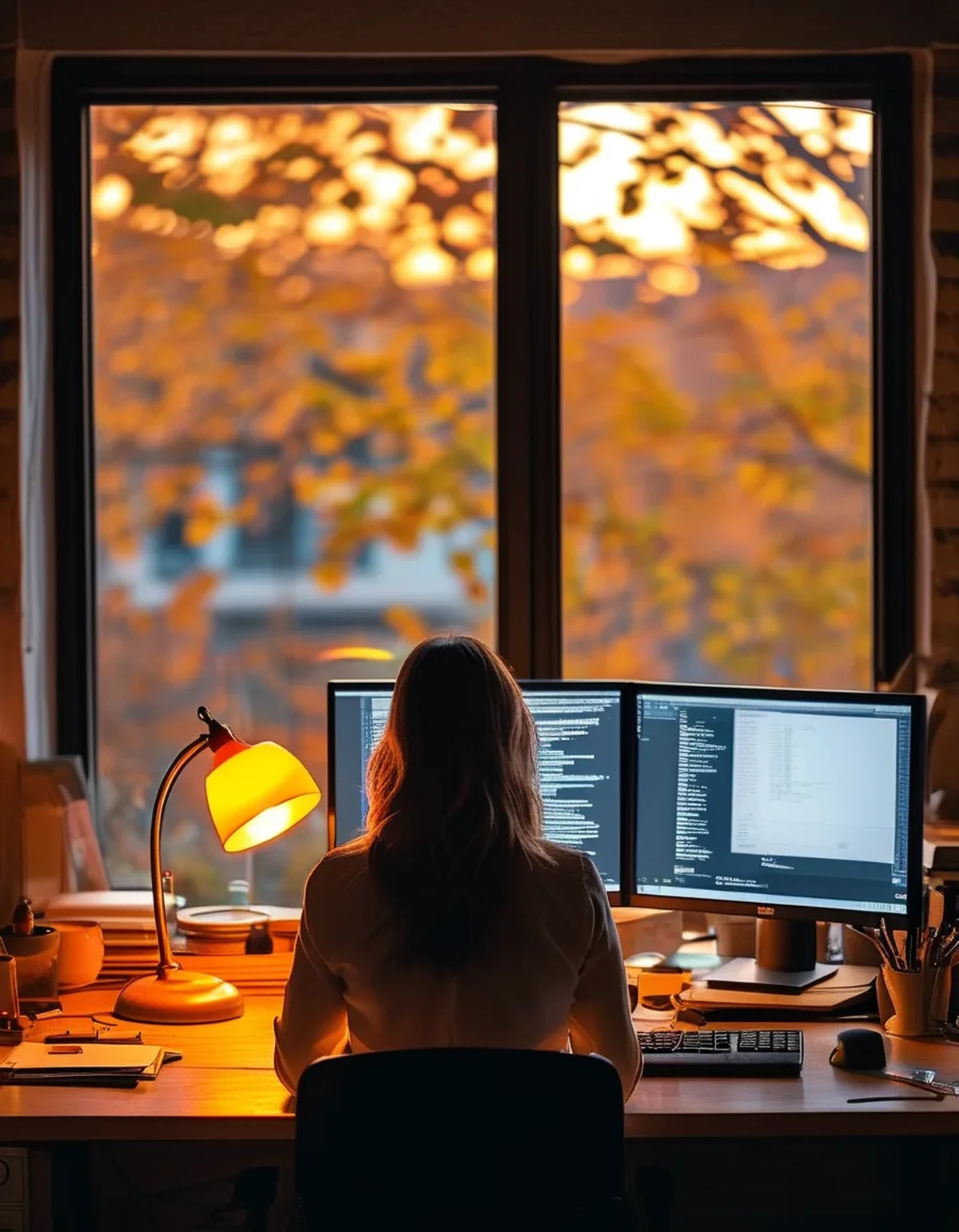
When ambient light drops, several things happen automatically. You lean in toward the screen, because reduced contrast makes text harder to resolve. You tilt toward whatever light source exists. And your pupils dilate, reducing depth of field, which makes near work slightly harder to focus and encourages you to move closer still.
A head moved forward by two inches increases the load on the neck substantially, because the weight sits further in front of the spine and the muscles hold it there. That is a mechanical fact and it does not require any change to your furniture.
Then there is the screen brightness mismatch. A bright screen in a dark room is a high-contrast source that causes squinting and forward lean, and squinting recruits the muscles at the base of the skull. This is the mechanism behind the specific headache that starts behind the eyes and ends up in the neck.
All of it happens gradually, which is why nobody connects October’s neck pain with September’s sunset time.
What else changes in autumn?
Cold, and where you spend the evening.
Cold raises resting muscle tone. In a cool room, the shoulders elevate slightly and the upper trapezius holds more tension continuously. That is an involuntary thermoregulatory response, and it means your neck starts the day with less slack. A drafty room or a seat near a window makes it worse and is easy to miss.
Evening device time moves to the sofa. From late September people spend more evening hours indoors, and sofa posture is far worse than desk posture - a phone held low in the lap produces a head angle of forty five degrees or more, which is the worst common posture for the neck by a wide margin. The desk is not the problem in autumn; the two hours after the desk are.
Layers change how you sit. A thick jumper or a blanket over the shoulders subtly restricts movement and encourages a more static position, and static is what neck tissue tolerates worst.
And activity drops. Fewer walks, fewer outdoor breaks, and less general movement mean less circulation through the same tissue. Most people’s step count falls noticeably from October onwards, and movement is what has been keeping the neck tolerant of a mediocre desk all summer.
Myth vs Fact: Neck Pain and Screens
Myth: There is one correct posture you should hold. Fact: The best posture is the next one. Static loading is the problem, and a moderately imperfect position changed every twenty minutes beats a perfect one held for two hours.
Myth: Tech neck is caused by phones specifically. Fact: It is caused by sustained forward head position from any source, and for most working adults the largest contributor is a monitor slightly too low held for hours, not a phone held for minutes. The phone is worse per minute and the monitor accumulates more minutes.
Myth: A standing desk fixes neck pain. Fact: It changes the load on your back and legs and does very little for a monitor at the wrong height. People frequently develop the same neck pain standing, because the screen came up with them and stayed too low.
Myth: Stretching the neck is the answer. Fact: Stretching a muscle that is already overloaded and lengthened - which is what the upper back muscles are doing in a forward head posture - provides brief relief and does not address the cause. Strengthening the deep neck flexors and the mid-back, plus fixing the screen height, does.
Myth: If it only hurts in the evening it is not a real problem. Fact: Evening onset is exactly what cumulative postural loading looks like. It is the classic pattern, and it is the point at which it is most easily fixed.
What should you actually change?
Light, screen position, evening habits, and movement - in that order, because light is the one nobody addresses.
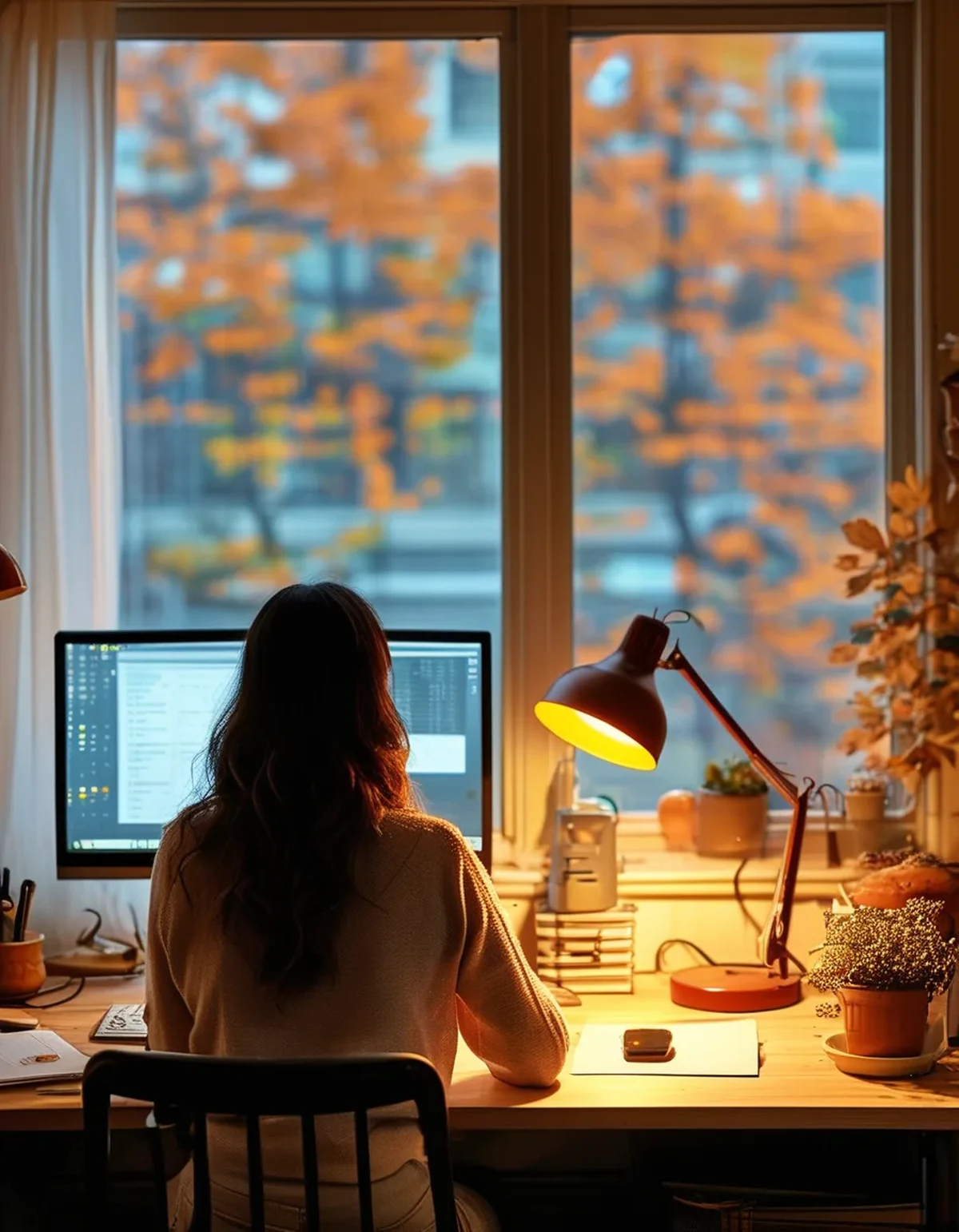
Add a lamp, do not brighten the screen. The problem is the contrast between a bright screen and a dark room. A warm lamp behind or beside the screen raises ambient light and removes the squint entirely. This is the single most effective and least obvious change on the list.
Raise the monitor. Top of the screen at or just below eye level, arm’s length away. A stack of books works. If you use a laptop, a stand and an external keyboard are not optional for evening work.
Fix the sofa hours. A cushion under the elbow to bring the phone up, or better, a tablet propped rather than held. Two hours a night at forty five degrees of neck flexion outweighs a great deal of good desk behaviour.
Warm the room or the shoulders. A warmer room, a scarf, or a heat pack across the shoulders in the evening reduces the resting tone that cold produces. This is a genuine and underrated fix in autumn.
Move every half hour. Stand, walk to another room, roll the shoulders, look out of a window at something distant. The distance focus matters too - sustained near focus tightens the whole system.
Keep the step count up. Deliberately, because it will fall otherwise. A short walk at lunchtime in daylight does more for autumn neck pain than any stretch, and the daylight has its own benefits.
And build two minutes of strengthening in - chin tucks, and something for the mid-back like a band pull-apart. Strength holds a position; stretching only borrows relief from it.
This is general information rather than medical advice. Neck pain with numbness, tingling, weakness in the arms, or severe headaches needs proper assessment rather than an ergonomic adjustment.
FAQ: Autumn Neck Pain Questions, Answered
Why does it hurt in the evening rather than the morning?
Because it is a cumulative load. Tissue tolerance falls as the day goes on, so the same posture becomes symptomatic later. Morning pain is a different pattern and often points at sleeping position or the pillow rather than the desk.
Would a different pillow help?
If you also wake up sore, yes, and it is worth looking at. If you wake fine and hurt by evening, the pillow is not the culprit and changing it will not help.
How long should it take to improve?
With the light, screen height, and evening habits fixed, most people notice a difference within one to two weeks. If nothing changes after a month of genuine adjustment, that is a reason to get it assessed rather than to keep experimenting.
TL;DR:
- Darker evenings make you lean toward screens and light sources, and a head two inches forward loads the neck substantially more.
- Cold rooms raise resting shoulder tone, and evening sofa device use is far worse than any desk posture.
- Add a lamp rather than brightening the screen, raise the monitor, prop the phone up, and warm your shoulders.
- Movement is what has been protecting you all summer, and it is the thing that quietly disappears in October.
If the neck pain arrived without any change to your setup, look at what changed around it. The sunset time is a more likely culprit than your chair.
Keep Reading
This article is for general informational purposes only and is not medical advice. Always consult a qualified health professional for guidance specific to you.