Why Couch Laptop Posture Builds a Different Tech Neck Than Your Desk Does
Quick Answer: Desk tech neck is a forward-head problem: screen roughly ahead, head drifting toward it. Couch tech neck is a different animal — a laptop in the lap drives forty-five to sixty degrees of neck flexion, the armrest lean adds a sideways bend and rotation, and the soft cushioning removes every support your spine uses to stack itself. It also feels completely fine at the time, because warm relaxed evening tissue stretches quietly and presents the bill at 6am. The fix is raising the screen, backing up the pelvis, and breaking the position every twenty minutes — not abandoning the couch.
Here is what makes the sofa version worse, why it hurts tomorrow instead of tonight, and the setups ranked.

What is mechanically different about couch posture?
Deeper angles, added twist, and a foundation made of foam.
The screen sits in your lap, so the flexion doubles. At a desk, a screen near eye height holds neck flexion in the fifteen-to-thirty-degree range. A laptop on your thighs drags the gaze nearly straight down — forty-five to sixty degrees of flexion, and the load on the neck’s supporting tissue climbs steeply with every degree. The often-quoted figures — a head that weighs ten to twelve pounds upright demanding several times that in deep flexion — describe exactly this geometry. The couch position is the expensive end of the chart, held for a movie-length sitting.
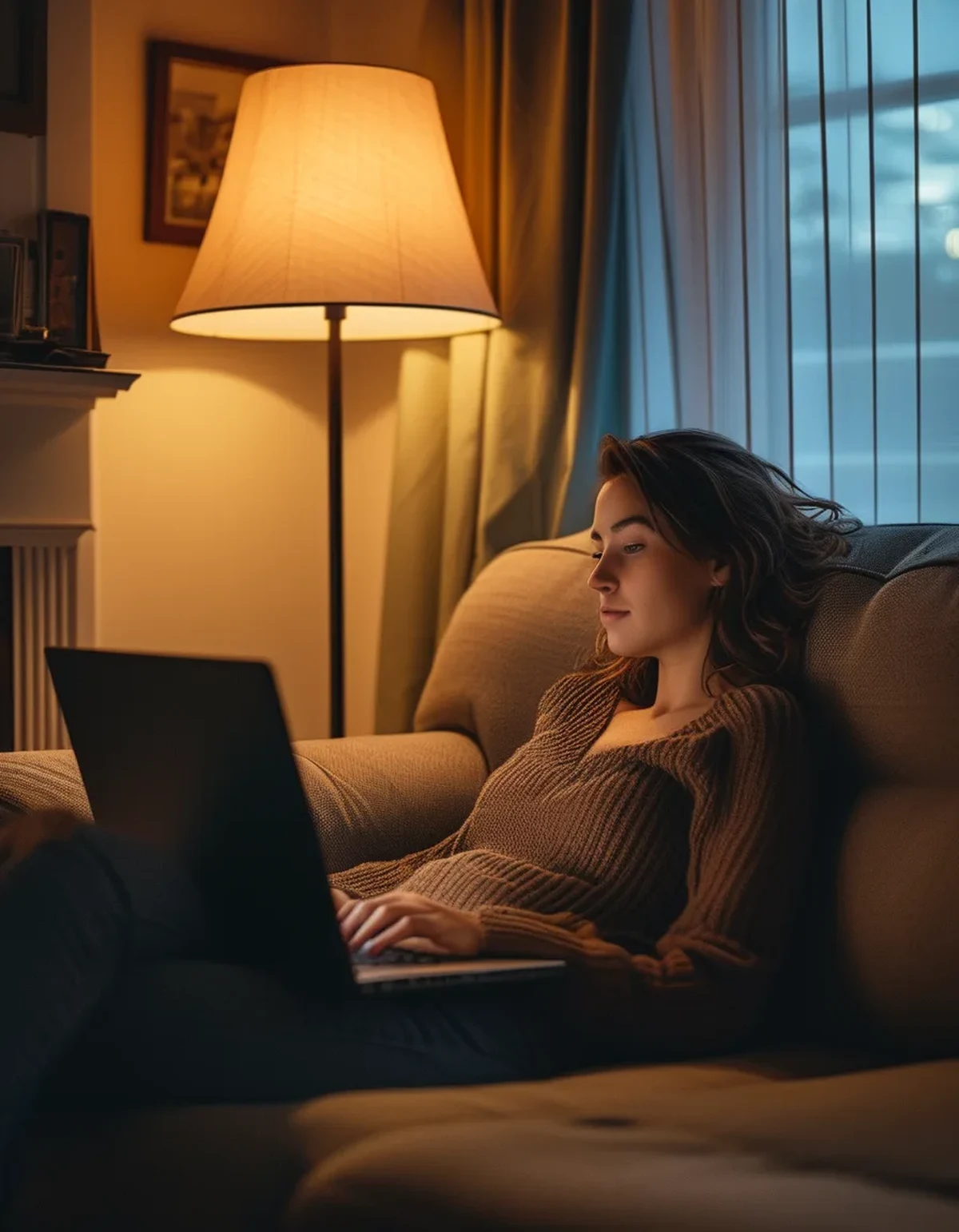
The corner lean adds the dimension the desk never had. Nobody sits square on a sofa; you settle into a corner, one elbow on the armrest, screen slightly off-centre — which puts the neck in flexion plus side-bend plus rotation simultaneously. Combined positions load the small joints and one-sided muscles far more than clean flexion, and they are why couch neck pain so often arrives on one side only.
The cushions dismantle your base. On a soft seat the pelvis tips backward, the lower back rounds, and the upper spine follows into a long C — from which the head must crane further just to face the screen. The desk chair, whatever its sins, at least held your pelvis level. The couch removes the foundation, then the lap screen punishes the collapse.
Same laptop, same spine, entirely different loading problem — which is why desk-day fixes alone never touch the evening version.
Why does it feel fine tonight and terrible tomorrow?
Because creep is silent, and evenings are engineered to hide it.
Sustained stretch quietly lengthens passive tissue. Hold ligaments and joint capsules at end-range and they gradually give — creep — reducing their support while producing almost no sensation. The discomfort signal that would normally prompt a shift is largely absent in slow sustained positions, which is precisely what a two-hour couch session is.
Evening conditions mute the remaining alarms. You are warm, relaxed, and absorbed in a screen; attention is the ingredient pain perception needs, and streaming removes it. Muscles guarding the position fatigue silently while the show runs.
The bill arrives with the morning stiffness window. Overnight, irritated tissue stiffens and inflammation settles in; the first neck turn of the day reports what 10pm concealed. The mystery morning neck — no injury, no bad pillow, just Tuesday — is very often Monday evening’s couch, delivered on schedule.
The pattern repeats because the cause and effect are eight hours apart. People blame pillows, mattresses, drafts, and sleeping funny — and re-buy all of them — while the actual dose happens nightly in the living room. One diagnostic habit settles it: note couch-laptop evenings in your phone for two weeks and match them against rough mornings. The correlation usually ends the mystery in the first week.
None of this makes the couch a villain. It makes the couch a place where position needs managing, because your body will not volunteer the warning.
5 Couch Setups Ranked From Worst to Least Bad
5. Lying on your side, head propped on the armrest, laptop on the cushion. The champion of tomorrow-morning regret: maximum side-bend at the neck, shoulder pinned, screen at a diagonal. Ten minutes reads as harmless; an episode is a cervical event.
4. Flat on your back, laptop on your chest. The neck flexes hard against gravity to see the screen and the shoulders round to stabilise the machine. Marginally better than side-lying only because it is at least symmetrical.
3. The corner slouch — pelvis slid forward, elbow on the armrest, laptop in the lap. The default American evening. Deep flexion plus rotation plus a collapsed base; everything in this article in one comfortable-feeling package.
2. Cross-legged, back against the backrest, laptop on a cushion in the lap. The cushion buys a few degrees of screen height and the backrest keeps the pelvis honest. Genuinely workable for shorter sessions if the head stays tall.
1. Upright in the corner with the back supported, feet on the floor or knees up, and the laptop raised on a lap desk plus a firm pillow. Screen high enough that the gaze drops only slightly, forearms supported, pelvis backed against a cushion. This is the least-bad couch — comfortable, sustainable, and roughly desk-grade angles on furniture never designed for them.
The ranking’s whole lesson: screen height and pelvis support decide the position; everything else is decoration. Raise the first, back up the second, and the couch becomes survivable.
What are the evening rules that keep couch time harmless?
Four habits, twenty seconds each, and none of them require leaving the sofa.
Raise the screen on a stack. A lap desk with a firm pillow underneath — or the coffee table pulled close for the laptop while you keep the keyboard preference honest — converts lap-gaze into a shallow downward glance. Every inch of screen height directly subtracts neck flexion; three or four inches subtracts a lot.
Back your pelvis into the corner and keep it there. A cushion behind the low back stops the backward tip that starts the whole C-shape collapse. Knees up with feet on the couch is fine — it actually helps hold the pelvis — as long as the screen rises to meet the eyes rather than the eyes diving to the lap.
Break the position every twenty minutes. Not a workout: sit tall, roll the shoulders back, turn the head fully left and right, and do two chin tucks — glide the head straight back as if making a double chin, hold two seconds. The episode-end autoplay countdown is a ready-made timer; spend it on the reset instead of the next-episode button.
Give the phone the same respect. The post-laptop scroll in the same slouch, phone at navel height, extends the dose another forty minutes. Elbow on a cushion, phone raised toward eye level — the identical raise-the-screen rule at smaller scale.
Then close the evening with sixty seconds: five chin tucks, a doorway chest stretch, and ten slow head turns each way. It unwinds the evening’s creep before sleep locks it in, and it is the difference between the morning neck and a normal Tuesday.
If mornings stay rough for weeks despite the setup — or pain runs down an arm, or hands tingle — that has left ergonomics territory: see a clinician. This is general information, not medical advice.
FAQ: Couch Tech Neck Questions, Answered
Is working from the couch ever actually fine?
In managed doses, yes. An hour with the screen raised, pelvis supported, and two position breaks is a reasonable evening. The damage pattern comes from the default version — lap screen, corner slouch, two unbroken hours — repeated nightly.
Why is my neck pain only on one side?
Almost certainly the corner-and-armrest lean: flexion plus side-bend plus rotation loads one side’s joints and muscles disproportionately. Swap corners for a week — or sit centred with the screen truly in front — and one-sided morning pain usually names its cause.
Are laptop stands and lap desks worth it for a sofa?
They are the fix. A firm lap desk plus a pillow raises the screen the critical inches, stabilises the machine, and keeps heat off your legs. Pair it with a low-back cushion and you have rebuilt desk geometry inside soft furniture for the price of a pizza.
My neck cracks when I do the head turns. Should I worry?
Painless clicks and pops during gentle movement are common and generally harmless — joints and tendons being audible. Cracking with pain, or a neck you feel compelled to crack for relief constantly, is worth a professional look rather than more self-adjustment.
TL;DR:
- Couch tech neck is deeper flexion than desk tech neck — plus side-bend and rotation from the corner lean, on a foam base that lets the pelvis collapse.
- It hurts tomorrow instead of tonight because sustained stretch creeps silently and warm, distracted evenings mute the warning; the mystery morning neck is usually last night’s couch.
- Screen height and pelvis support decide everything: lap desk on a pillow, cushion behind the low back, and a twenty-second reset every episode.
- Close evenings with chin tucks, a doorway stretch, and slow head turns; one-sided pain means swap corners; arm pain or tingling means see a clinician.
Tonight, put a pillow under the laptop and a cushion behind your back before you press play. Tomorrow morning’s first head turn is the report card.
Keep Reading
This article is for general informational purposes only and is not medical advice. Always consult a qualified health professional for guidance specific to you.