Why Your Neck Hurts More on Sofa Work Days Than Desk Days
Quick Answer: A desk provides external support at three points - feet, forearms, and back - so your muscles do not have to. A sofa provides support in the wrong places and none where it counts, which leaves your neck extensors holding your head forward against gravity for hours. The load is static and low-level, which is why you only notice it afterwards. Raise the screen and support the arms; the sofa itself is not the problem.
The sofa is comfortable for sitting.
It is not comfortable for holding a laptop, which is a different activity entirely.

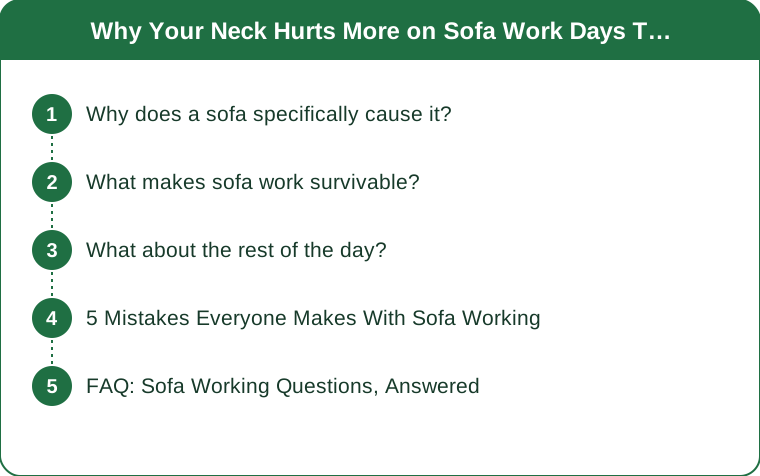
Why does a sofa specifically cause it?
Because comfort for resting and support for working are different requirements.
Your head is heavy and it sits forward of your spine. Holding it in a neutral position costs almost nothing; holding it tilted forward multiplies the load on the muscles at the back of your neck substantially. The further forward, the higher the cost - and a laptop in your lap puts your head as far forward as it goes.
A sofa gives you no forearm support. At a desk, your forearms rest on the surface, which takes the weight of your arms off your shoulders and neck. On a sofa, your arms are held up by your shoulders for the entire session.
The seat is too deep for an upright position. Sofa seat depth is designed for reclining, so sitting upright means either perching at the front edge or slumping back with a rounded spine. Neither position supports the neck.
And the screen is always too low. A laptop on your lap sits far below eye level, and the only way to see it is to look down. This is the core of it - the screen position determines the head position, and everything else follows.
The load is static, which is the worst kind. Muscles held at a constant low-level contraction fatigue in a way that movement does not produce. Static holding for hours is more demanding than intermittent effort, which is why the ache appears afterwards rather than during.
And you stay longer because it is comfortable. A desk gets uncomfortable and prompts you to move. A sofa lets you sit still for three hours, which is the actual danger.
What makes sofa work survivable?
Four changes, none of which require moving to a desk.
Raise the laptop. A cushion, a lap desk, a stack of books - anything that brings the screen closer to eye level. This is the single highest-value change and it takes ten seconds.
Support your forearms. A cushion under each elbow, or a firm cushion across your lap that your arms rest on. Taking the weight of your arms off your shoulders removes a large share of the load.
Fill the gap behind your lower back. A firm cushion in the lumbar curve lets you sit upright without holding yourself upright. A soft sofa cushion is not enough - it compresses and disappears.
Put your feet on something. Feet flat on the floor or on a low stool stabilises the pelvis, which stabilises everything above it. Dangling feet or crossed legs undermine the whole position.
Use an external keyboard if the session is long. Raising the laptop puts the keyboard too high; an external keyboard on your lap lets you fix the screen height without wrecking your wrists. The combination is what actually works.
And set a timer. Twenty-five or thirty minutes, then stand and move for a minute. The timer matters more on a sofa than at a desk precisely because nothing else will prompt you.

What about the rest of the day?
The sofa is rarely the only contributor, and the others compound.
Phone position is the biggest one nobody counts. Looking down at a phone puts your head in the same position, and phone use adds up to hours. Raise the phone to face height rather than lowering your head to it.
Reading in bed is a similar geometry. Propped up on pillows with a book or tablet in your lap is a sustained forward head position, usually held longer than any work session. Support the book, not just your back.
Cold weather makes hunching worse. Cool rooms produce a slight shoulder lift and forward posture that people hold without noticing. As autumn arrives, this becomes a real contributor - a warmer room or an extra layer changes your posture more than you would guess.
Movement is the actual treatment. Neck muscles held static need movement more than they need stretching. Chin tucks, shoulder rolls, and simply standing up every half hour do more than any single stretch.
Strength matters over the longer term. Upper back and deep neck flexor strength change how long you can hold a position before fatiguing. Two short sessions a week is enough to make a difference.
And persistent symptoms deserve assessment. Pain that radiates into the arm, numbness, tingling, or weakness is a different situation from muscle fatigue. That combination is worth seeing someone about rather than adjusting cushions. This is general information, not medical advice.
5 Mistakes Everyone Makes With Sofa Working
Treating the sofa as a break from the desk. It is a change of position, not a rest. A badly set up sofa is harder work than a well set up desk, which is the exact opposite of how it feels.
Raising the laptop without an external keyboard. Fixing the screen height puts the keyboard too high and moves the problem to your wrists and shoulders. The two changes go together or neither works properly.
Using soft cushions for support. A soft cushion compresses under load and provides nothing after the first minute. Firm support in the lumbar curve is what actually holds a position.
Sitting cross-legged for hours. It feels comfortable, tilts the pelvis, and rounds the lower back - which pushes the head further forward. Feet down and supported is the position that helps the neck.
Staying past the point of noticing. The reason sofa sessions get long is that nothing becomes uncomfortable enough to move you. A timer is the substitute for the discomfort signal a desk chair would give you.
And the bonus mistake: stretching instead of moving. Static stretching of an already-fatigued muscle gives brief relief and does not change the load. Movement and position changes are what actually resolve it.
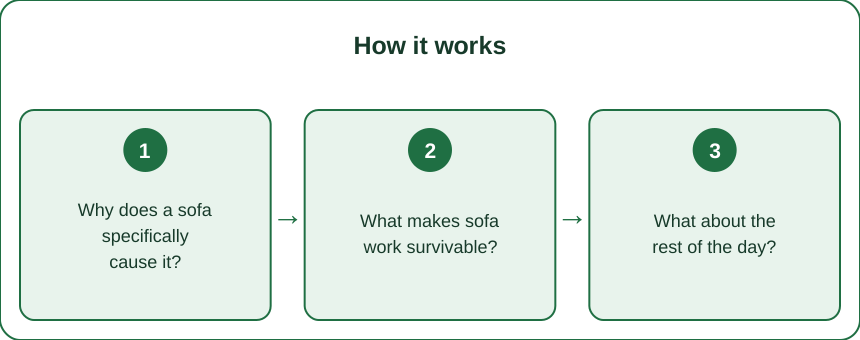
FAQ: Sofa Working Questions, Answered
Is working from a sofa ever fine?
For short sessions, yes - reading, calls, or anything not requiring sustained typing. The problem is duration and typing, not the furniture. Under half an hour with a raised screen is generally unremarkable.
What is the best single item to buy for it?
A firm lap desk that raises the laptop, used with a separate keyboard. The pair costs very little and converts a sofa into a workable setup rather than a compromise.
Why does the ache appear in the evening rather than while I work?
Because static muscle loading builds fatigue gradually and the pain signal lags. The evening ache is the bill for the afternoon, which is exactly why the position never feels wrong at the time.
TL;DR:
- A desk supports feet, forearms, and back; a sofa supports none of them where it matters.
- A laptop in your lap forces a forward head position, which multiplies the load on your neck extensors.
- Raise the screen and add an external keyboard - the two changes only work together.
- Firm lumbar support and feet on the floor let you sit upright without holding yourself upright.
- Set a thirty-minute timer - the sofa removes the discomfort cue that would move you.
Next sofa session, put the laptop on a firm cushion and rest your elbows on another one. Two cushions, ten seconds, and most of the load disappears.
Keep Reading
This article is for general informational purposes only and is not medical advice. Always consult a qualified health professional for guidance specific to you.