Why Your Neck Hurts More When You Hold Your Phone in Your Left Hand
Quick Answer: Holding a phone in one hand tilts your head toward that side and rotates it slightly, which loads the neck asymmetrically for however long you scroll. Your non-dominant hand typically holds the phone lower and closer to your body — a greater head tilt — while the dominant hand types. Over hours daily, one side takes a consistently larger share. Switch hands, raise the phone, and interrupt the position.
One side aches.
The other does not.
Because you have been holding a 200g object in the same asymmetric position for years.

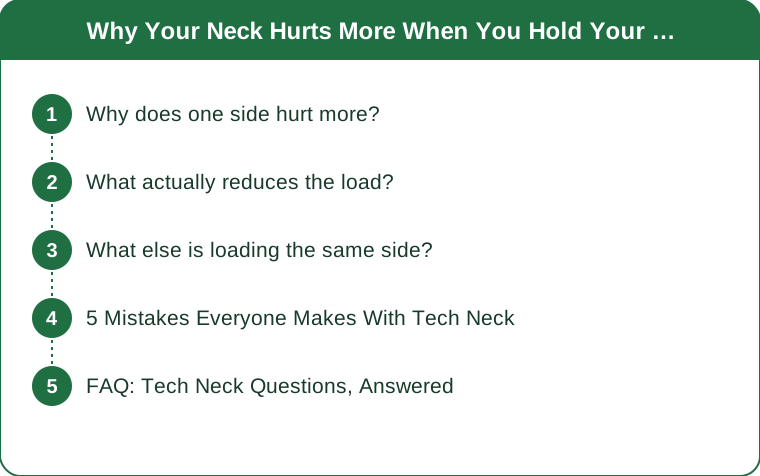
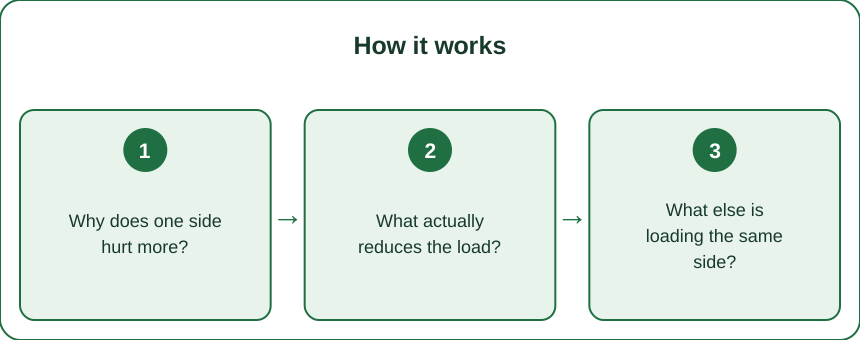
Why does one side hurt more?
Six asymmetries in a habit most people think of as symmetrical.
Head tilt loads the neck steeply. The head weighs roughly 5kg. Tilting it forward increases the effective load on the neck substantially — at 45 degrees of flexion the load on the cervical spine is several times its neutral value. Add a sideways tilt and that load concentrates on one side.
Your non-dominant hand holds the phone lower. Most people hold the phone with the non-dominant hand and interact with the dominant one. The holding hand tends to sit lower and closer to the body, producing a greater forward and lateral head tilt.
Rotation compounds flexion. You rarely look at a phone straight on. A small rotation combined with flexion loads the facet joints and the muscles on one side considerably more than pure forward flexion does.
The shoulder joins in. The holding arm is often elevated slightly and held in one position, which loads the upper trapezius on that side — frequently the actual source of what people call neck pain.
Duration is the multiplier. Sustained low-level loading fatigues muscle far more than brief high loads. Three to four hours of phone use daily, in the same asymmetric position, is a substantial cumulative exposure.
And it stacks with your desk and your bag. If you also carry a bag on the same shoulder and angle your monitor slightly to one side, all three asymmetries point the same way. That is usually the case, because they are all organised around the same dominant hand.
What actually reduces the load?
Six changes, ordered by how much difference they make.
Raise the phone toward eye level. Bringing the screen up rather than dropping your head down is the single biggest change. It looks slightly odd for a week and then it is normal.
Switch hands deliberately. Not because the other side is better, but because alternating spreads the load. Set the phone in the other hand consciously several times a day until it stops feeling awkward.
Use both hands for longer sessions. Two-handed holding at chest-to-face height is far more symmetrical than one-handed at waist height.
Prop the phone rather than hold it. For reading, video or long messages, propping it against something at eye level removes both the tilt and the arm load entirely.
Interrupt every 20 minutes. A few seconds of looking up and gently retracting the chin resets the position. Position variety beats perfect posture, and it is realistic in a way that maintaining perfect phone posture is not.
Strengthen the deep neck flexors and mid-back. Chin tucks (3 sets of 10, holding 5 seconds), band pull-aparts and prone Y raises, three times a week. This is the part that changes tolerance rather than just relieving symptoms.
Seasonal note: phone use rises as evenings darken and outdoor time falls, and cooler weather means more time hunched with shoulders raised. Autumn is when neck symptoms most commonly appear, which makes it the right moment to fix the habit rather than the wrong moment to notice it.

What else is loading the same side?
Six related exposures that usually point the same direction.
Bag strap side. A bag consistently carried on one shoulder elevates and loads that trapezius for hours. Alternate sides, or use a backpack with both straps — which most people own and half of them wear on one shoulder anyway.
Monitor angle. A screen positioned even slightly off-centre means hours of small sustained rotation. Centre it directly in front of you, and check it, because monitors drift.
Sleeping position. Side sleeping with a pillow that is too flat or too thick puts the neck in sustained lateral flexion for hours. Pillow height should fill the gap between your ear and the mattress so the neck stays neutral.
Driving posture. Head position while driving is sustained and often slightly rotated, particularly if you glance at a mounted phone or screen. Mount it as centrally and as high as is legal and safe.
Reading in bed. Propped up on pillows with a book or laptop is deep sustained flexion. Raising the object rather than dropping the head applies here too.
And the desk-to-phone chain. Many people finish eight hours at a desk with forward head posture, then spend the evening on a phone in the same posture. There is no recovery period in between, which is what turns a tolerable exposure into a persistent one. This is general information, not medical advice — pain radiating into the arm, numbness, tingling, weakness, or headaches with neck pain need professional assessment.
5 Mistakes Everyone Makes With Tech Neck
Mistake one: stretching without strengthening. Stretching a tight upper trapezius feels good for twenty minutes. The muscle is tight partly because it is overworked, and strengthening the mid-back and deep neck flexors is what changes the pattern.
Mistake two: trying to hold perfect posture. Nobody sustains it, and rigid holding is fatiguing in its own right. Frequent small changes of position beat one correct position.
Mistake three: assuming the phone is the only cause. Desk, bag, pillow and driving are usually all loading the same side. Fixing one of five does a fifth of the job.
Mistake four: ignoring the pillow. You spend seven or eight hours in one position overnight. A pillow that leaves your neck laterally flexed all night outweighs a lot of daytime effort.
Mistake five: treating one-sided pain as a mystery. One-sided load produces one-sided pain. The question is not why it is asymmetric — it is which of your asymmetric habits is responsible, and there are usually three.
And the bonus one: waiting for it to become severe. Early habit changes are easy and effective. Established symptoms take considerably longer to resolve, and by then the strengthening work is harder to start.
FAQ: Tech Neck Questions, Answered
Why does only one side of my neck hurt?
Because phone-holding, bag-carrying and screen angle are all asymmetric, and they usually all favour the same side.
How much load does looking down add?
The head weighs about 5kg in neutral. At 45 degrees of forward flexion, the effective load on the cervical spine is several times that.
What is the single best change?
Raise the phone toward eye level instead of dropping your head to it.
How often should I change position?
Every 20 minutes, even briefly. Look up, gently tuck the chin, and carry on.
What exercises actually help?
Chin tucks, 3 sets of 10 with a 5-second hold, plus band pull-aparts and prone Y raises, three times a week.
Does my pillow matter?
A great deal. It should fill the gap between your ear and the mattress so your neck stays neutral for seven or eight hours.
When should I see someone?
Pain radiating down an arm, numbness, tingling, weakness, or headaches accompanying neck pain all warrant professional assessment.
TL;DR:
- One-sided neck pain comes from one-sided load — phone hand, bag shoulder and screen angle usually all favour the same side.
- Your head weighs about 5kg, and forward tilt multiplies the load on your neck several times over.
- Raise the phone, switch hands deliberately, and prop it for long sessions.
- Interrupt every 20 minutes — position variety beats perfect posture.
- Strengthen with chin tucks 3x10, band pull-aparts and prone Y raises, three times weekly.
Right now, notice which hand is holding your phone and how low it is. That is the habit, and raising it is free.
Keep Reading
This article is for general informational purposes only and is not medical advice. Always consult a qualified health professional for guidance specific to you.